
How to Search for Competitors in Your Niche

Ready to move from theory to action? Let’s break down how to actually search for business competitors — and if you caught my last video, you’ll remember why it’s so important to separate business competitors from channel ones.
I’m Olga Kolomiiets, a CMO driving strategy for B2B IT companies.
How Data About Business Competitors Can Be Useful to Us
Let’s start with a simple question — why is it important to know who our competitors are?
Here are a few key reasons:
- To set realistic goals.
If we see that a similar company reached, say, $1M in revenue in 6 months — we know it’s possible. That gives us a benchmark and helps us plan more confidently. - To track market share.
When we understand our competitors’ size and growth, we can better evaluate our own progress. Are we growing, stagnating, or falling behind? - To learn from what they’re doing.
By watching their marketing, content, or sales moves, we can spot what’s working — and improve on it for ourselves. - To stay competitive.
Analyzing their features, pricing, or service terms helps us make sure we’re not falling behind or missing something critical. - To define what makes us different.
Knowing the competitive landscape helps us identify our unique point of differentiation — and clearly position our product by communicating why someone should choose us over others.
It all starts with knowing how to search for competitors the right way, so you’re comparing yourself to the right players.
I’m curious — how do you use competitor insights in your business? Let me know in the comments!
Creating the List of Competitors: Collecting from Market Research Firms
Let’s imagine we’re the founders of a marketing automation platform, and we’re entering the US and European markets. Naturally, the first step in building our strategy is identifying who our real competitors are.
So, what’s the algorithm here? How do we build that list?
Start by collecting potential competitors from trusted sources.
I usually look for rankings like Top Marketing Automation Software Companies — and I want these lists to come from reliable industry sources like Statista, Business Research Insights, or others with real data behind them. That’s one of the most effective ways how to find business competitors at the initial stage.
But how do we find the right source or report?
Simple — I ask ChatGPT 😄
I’d type something like:
👉 “Please find me the statistics of top marketing automation software companies from trusted sources. Include the links.”
And here’s what I got!
One of the links led me to a super useful report:
https://electroiq.com/stats/marketing-automation-statistics
Of course, I always check the link — I look at the data quality and whether the source is trustworthy before using anything.
And boom — jackpot!
This report not only lists the top marketing automation companies, but also provides their market share — exactly the kind of data we need to build a solid competitor table.
But here’s an important cautionary note: we should always approach such charts with a critical eye.
It’s essential to check the methodology behind the data — including factors like the sample size, geographic coverage, the types of platforms included, and how market share is actually defined (whether by revenue, user count, usage frequency, etc.). Without this context, the numbers can be easily misinterpreted.
And to be honest, market research firms don’t always make this information fully transparent — or the diagrams they provide may simply not meet your specific needs.
So while this chart is a great starting point when researching marketing automation competitors, I wouldn’t rely on it as the only source. It’s always a good idea to cross-check it with other industry reports and conduct your own market research to get a more complete picture.
So let’s see how to do the research ourselves.
Creating the List of Competitors: Finding via Google Search
The first step I recommend is going straight to Google Search.
Why? Because if a platform consistently ranks in the top organic results, it’s likely a strong player with high authority and visibility — and potentially a key competitor.
👉 Don’t forget:
Switch your browser to the IP of the target region (e.g. the US or a European country), and scan the top 20 organic results for the query “marketing automation software.”
Add the companies you find to your competitor draft table.
Later, we’ll validate whether they are true business competitors — not just channel competitors I talked about in my previous video.
Creating the List of Competitors: Identifying via Review Platforms
The second step is to check top software review platforms — the places where your real marketing automation competitors are almost guaranteed to show up.
Here are my go-to sources:
- Capterra
https://www.capterra.com/marketing-automation-software/?sort=most_reviews
Sort by most reviews. The logic is simple: the bigger the company, the more reviews it usually has.
- G2
https://www.g2.com/categories/marketing-automation?order=popular
Sort by popularity, and grab the top 10–15 platforms.
- TrustRadius
https://www.trustradius.com/categories/marketing-automation?top=true
Filter by Top Rated Only.
- GetApp
https://www.getapp.com/marketing-software/marketing-automation/?sort=reviews
Sort by User Rating.
Pro tip: Don’t just take every company from these lists.
Stick to those that actually overlap with your product’s feature set.
For example, if you see Jira listed — it may show up under “marketing automation”, but it’s really a project management tool, not a direct competitor. Always check the description or feature section to confirm.
What if your product is in a super niche category?
Let’s say, for example, you’re building a Cold Email & LinkedIn Automation tool.
That’s already a pretty narrow niche, right?
The first step, as usual, is straightforward:
Check the top 20 organic results in Google Search for relevant queries. That’s a solid starting point for any niche.
But when it comes to software review platforms like Capterra, G2, or TrustRadius, things get a bit trickier.
Your niche might be so specific that there’s no dedicated category for it at all.
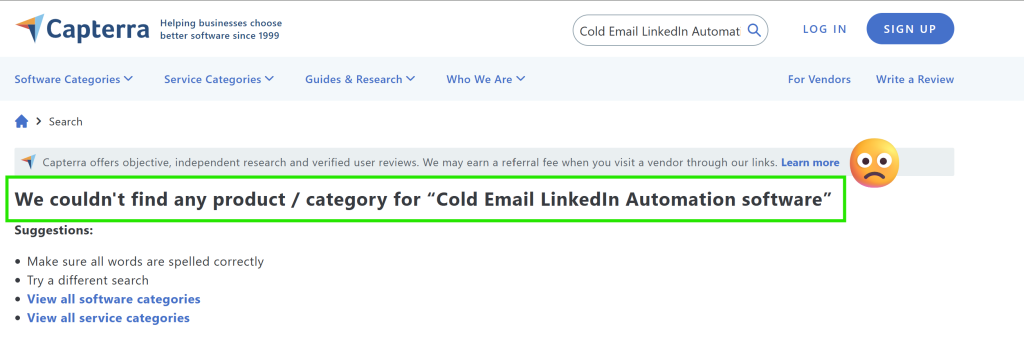
A bit of a tricky situation, isn’t it?
If you’re wondering how to find competitors in your niche in this case — here’s what I recommend:
👉 Ask ChatGPT something like:
“Please find Cold Email & LinkedIn Automation software on capterra.com / g2.com / trustradius.com.”
Once you get the list of relevant tools:
- Visit each software profile on those platforms.
- Double-check the accuracy of the data — is it really offering the same features as your product?
- If yes — add it to your draft competitor table for further validation and analysis.
Filtering Competitors by Core Functionality
This way, even if you’re operating in a niche where structured categories don’t yet exist, you can still build a relevant and meaningful competitor list by being resourceful.
So, let’s return to our case. We’ve built a list of 34 potential competitors in the marketing automation space.
The next step is to filter that list — and identify which of those tools are entirely or primarily focused on marketing automation, and which offer it as just one feature among many.
This distinction is crucial.
When selecting competitors for analysis, you want to compare your product to others with similar core functionality — otherwise, the insights you draw might be irrelevant or even misleading.
For instance, HubSpot or Salesforce Marketing Cloud can’t be considered direct competitors to platforms like MailerLite, Omnisend, or Ortto, even though all offer some form of marketing automation.
Why? Because HubSpot and Salesforce are broad, full-suite CRM and customer experience platforms, integrating sales, service, analytics, CMS, and complex enterprise-level automation workflows. In contrast, MailerLite, Omnisend, and Ortto focus entirely or primarily on marketing automation, email workflows, and customer journeys—especially for SMBs or ecommerce teams.
So, if you’re analyzing market share, pricing, or user base, it wouldn’t make sense to compare a lightweight automation platform with a giant like Salesforce — whose numbers reflect multiple business units, not just marketing automation.
After researching the scope and positioning of each company on our list, I narrowed it down to 15 platforms that are truly focused on marketing automation.
This step is a practical example of how to know your competitors in business — by going beyond surface-level similarities and focusing on core functionality.
Now it’s time to move forward —
👉 Let’s start the business competitor validation phase in my next video.